Since October 9, 2025, IBAN verification has become mandatory in Belgium and in all European countries. Belgian banks thus have a new system to reduce input errors and fight against bank fraud. This is a regulatory novelty, but above all an evolution in terms of payment procedures open to individuals and businesses.
Why was it put in place? How does it fit into daily banking practices and what are its impacts on the internal procedures of Belgian banks and institutions? If you're asking yourself these questions, you've come to the right place.
IBAN verification is becoming systematic in Belgium
IBAN verification arrives in Belgium to secure all financial flows.
Account number errors can in fact have consequences, ranging from late payments to more or less significant financial losses.
At the same time, the Belgian financial landscape has seen an increase in fraud attempts involving electronic payments.
Faced with this double problem, automatic IBAN control (also called beneficiary verification) is proving to be a particularly powerful weapon!
Applied at the national and European level, this practice standardizes the security of transactions. It protects all financial players but also their customers.
Frauds that consisted of falsifying invoices by impersonating a company and only changing the account number are now easily identifiable.
How does this check work?
Since the establishment of the system in Belgium, IBAN verification has been both free, automatic and directly integrated into the bank transfer process.
When an individual or a business makes a payment, the bank ensures that the account number corresponds to the name of the beneficiary entered. If a discrepancy is detected, the system immediately reports the problem and allows for certain arrangements to be made before the transfer is not completed.
The alert is sent to the sender of the transfer. He then has all the information he needs to cancel, correct or validate the payment. This control is based on reliable databases and standardized protocols at European level.
What is the format of a Belgian IBAN?
An IBAN (International Bank Account Number) is a unique code that identifies a bank account internationally.
In Belgium, it consists of 16 characters: 2 letters for the country code (BE), followed by 2 control numbers, then 12 digits representing the national account number.
Example of a Belgian IBAN code: BE68 5390 0754 7034
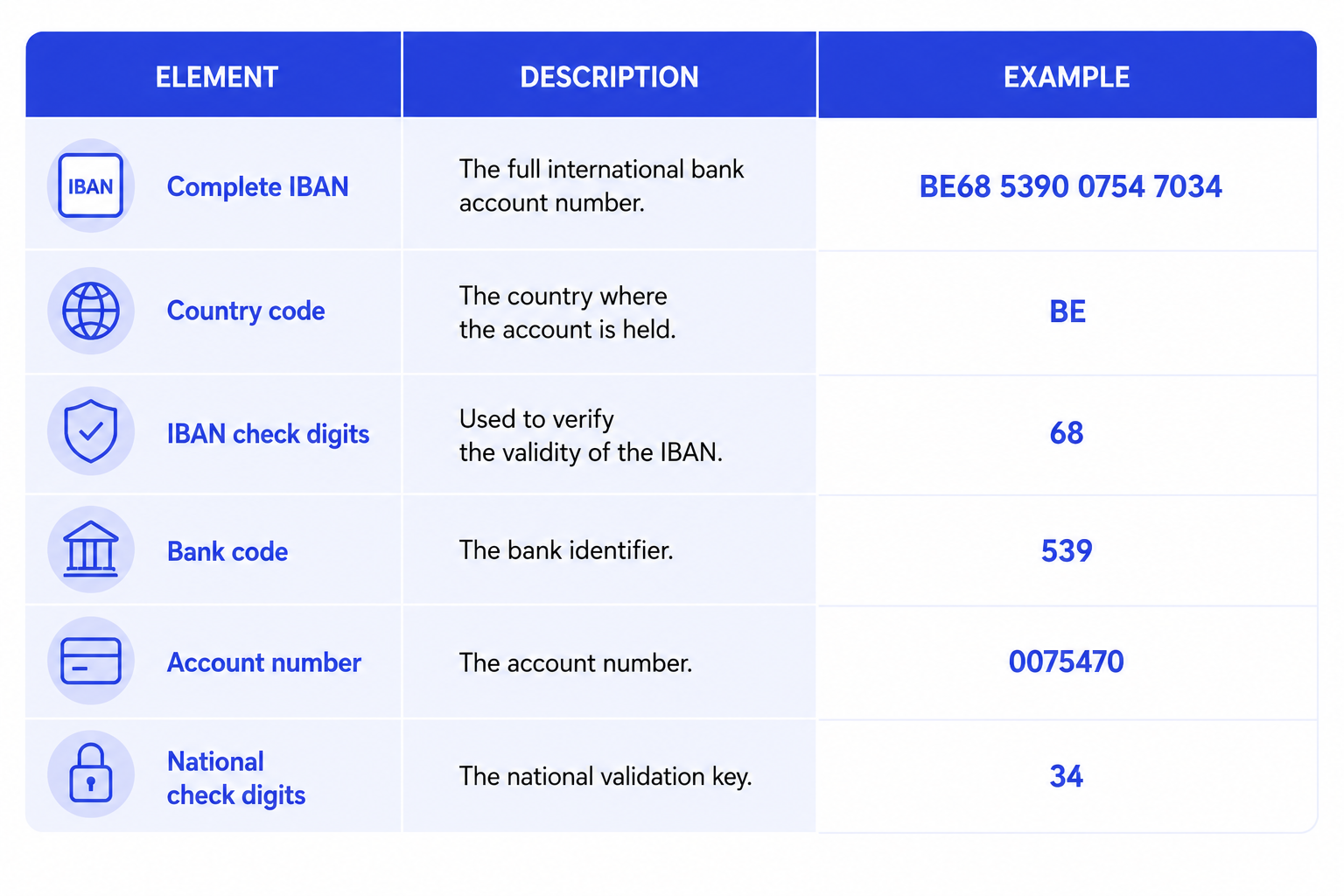
This standardized structure allows banks to quickly check the validity of an account.
How does IBAN verification impact banks?
The IBAN verification introduced in Belgium obviously involves some changes for banking institutions. As this is a systematic check, banks are required to add this verification step to each transfer procedure.
Many financial institutions were already applying this exam, which became mandatory since October 9, 2025. A check that involves technical adjustments, in particular to connect the payment systems to the database that validates IBAN/name matches. These changes require organizational adaptations to train teams and anticipate all possible detection scenarios.
Beyond regulatory compliance and technical issues, the system has a direct impact on risk management :
- financial losses
- Waste of time
- customer disputes
- reputational risks.
Banks and their customers can now detect and stop suspicious transfers before a transaction harms them.
In addition, the IBAN verification requirement pushes Belgian banks to further automate their checks. They centralize data and set up early alerts. A new approach in the fight against bank fraud emerges from these developments. More connected and above all, more proactive!
How else can I check an IBAN?
The automatic IBAN verification process is not the only way to detect an error or an attempt at fraud. In Belgium, the Finovox solution for detecting false documents makes it possible to go well beyond simple control.
Thanks to one of its modules called Fraud Analysis, Finovox analyzes the consistency of the document submitted, whether it is an IBAN, an identity document or an invoice. Were screened:
- The consistency of the dates
- The logic of the amounts
- The correspondence of identities
- the alignment between the textual content and the context of the document.
But the inspection does not end there. Finovox also compares document data with reliable external databases, such as SEPAmail or Papers.
These intersections make it possible to detect inconsistencies that are often invisible to the naked eye. They reveal fraud attempts even when the analyzed document seems perfectly credible.
Banks and financial institutions can therefore rely on an intelligent process to add a layer of security to their internal audits and speed up their decisions.
Sommaire
.jpg)